
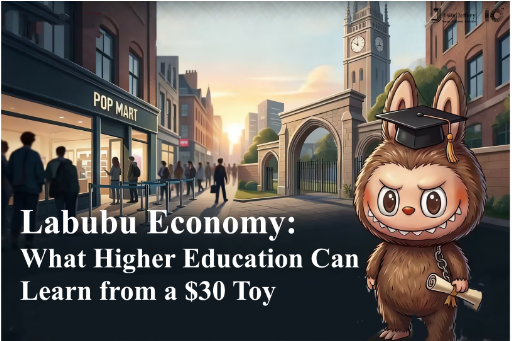
Labubu Economy: What Higher Education Can Learn from a $30 Toy
In 2026, some of the most effective recruitment insights are not found in admissions offices but in the 5:30 AM queues at POP MART stores.
The sustained global craze for Labubu shows that today’s young people are changing their standards for value. They are moving away from a focus on “long-term functional utility” toward a more immediate form of “Identity Capital.”
This shift in values is not confined to retail but instead reflects a broader psychological change in how this generation makes their educational decisions. As traditional academic ROI faces more challenges, students are applying similar consumer-driven standards to their college choices.This evolution is particularly evident in the Southeast Asian market, where the economic promise of a degree is undergoing a significant correction.
I.Structural Challenges to Traditional Academic Return on Investment (ROI)
In core Southeast Asia markets, the economic attraction of traditional degrees is undergoing a fundamental realignment. Rather than serving as a guaranteed path to financial security, the return on investment for Higher Education is now being challenged by widening fiscal gaps and shifting employer expectations.
1.The Mismatch Between Salary Levels and Tuition Increases:
The economic value of Higher Education in Singapore and Malaysia is currently facing a correction as annual tuition increases of 6.0% (QS, 2025) outpace the 4.3% to 4.8% salary growth projected by Aon for 2026. This disparity, combined with attrition rates reaching 19.3%, creates a financial deficit that challenges traditional ROI models. As educational investment becomes harder to recover, students are increasingly prioritizing university brands that provide immediate Identity Capital over long-term functional utility.
Source: Aon 2025 Salary Increase and Turnover Study (Asia Newsroom)
2. Degree Depreciation and the Erosion of Functional Value
Data from the QS indicates a significant shift in student perception. Currently, only 42% of prospective students cite a high graduate employment rate as a primary factor for course choice. Furthermore, the priority of personal interest in the subject has dropped to 38%. This suggests that a degree is no longer viewed as a guaranteed insurance for professional success, leading students to apply more pragmatic consumer standards.

3.The Rise of Alternative Certifications:
As artificial intelligence and digital transformation accelerate, Southeast Asian companies are significantly increasing their recognition of “micro-credentials” and “industry certifications.” Approximately 58% (QS-GER) of surveyed recruitment managers state that they prefer to hire candidates with specific technical certifications rather than graduates who hold only traditional degrees.
II. Students Applying Consumer-Driven Standards to University Selection
When the traditional function of career security weakens, students begin to pivot toward the pursuit of Identity Capital and social attributes. This means that in their eyes, a university is transitioning from a “functional factory” into a “High-Value Consumer Brand.”
1.Campus Experience as “Brand Premium”:
According to the QS, the priority of “Campus Life Quality and Community Identity” has surpassed “Academic Reputation” for the first time in university selection. Approximately 65% of surveyed students state that they are willing to pay higher tuition fees for schools that provide a “unique lifestyle label.”
2.Social Media-Driven “Identity Signals”:
In Vietnam and Thailand, over 71% (QS) of students research universities through platforms such as TikTok or Lemon8. Their focus has shifted from technical laboratory configurations to whether the university brand serves as a Visual Signal on social networks. This behavioral pattern is highly consistent with the psychological mechanism of purchasing a Labubu to hang on a luxury bag, as it represents an immediate expression of self definition through brand association.
3.Shifting from “Instrumental Learning” to “Relational Investment”:
The latest industry analysis from LinkedIn points out that prospective students in Southeast Asia are increasingly concerned about the “Social Network Capital” that a university can provide. They view Higher Education as an entrance ticket to specific high-net-worth social circles. Driven by this psychology, the stronger the brand power, the higher the value of the underlying elite alumni network and resource access, which attracts applicants seeking long term social mobility and class belonging.
III.Strategic Realignment: Transitioning Toward Immediate Value and Identity Signaling
The Labubu Economy provides a critical strategic reference for our understanding of Enrollment Growth in 2026. It highlights three fundamental shifts in the student journey:
1.Rewards: From “Wait” to “Now”
Higher education has long been the ultimate “delayed gratification” product because it requires a four-year wait for a single payoff. In contrast, Labubu’s success reveals a different path driven by Variable Ratio Reinforcement. The uncertainty of a “blind box” mimics the feedback of a slot machine, providing an instant psychological hook.
This suggests that in 2026, enrollment is becoming a “Ritual of Discovery.” Beyond distant graduation prospects, the ability to provide “Intellectual Dopamine” or micro-wins during the early brand journey is becoming a critical factor in capturing modern attention.
Brand: From “Perfect” to “Real”
Most university branding tends to remain focused on a “Feature Buffet” of rankings and sterile campus photos. However, the “ugly-cute” aesthetic of Labubu suggests that in a high-anxiety era, many people seek Emotional Resonance over standardized perfection.
Trust in “perfect templates” is shifting toward a hunger for authenticity. This means that to increase conversion, the university could evolve from a rigid credentialing body into a human-centric Lifestyle Companion. Enrollment is far more likely to happen when a student feels a personal connection to the brand, rather than just a passive appreciation for its statistics.
Value: From “Tool” to “Signal”
The Labubu logic thrives on “User-Led Redefinition.” While the toy was never designed for luxury markets, it has become a must-have accessory on luxury bags, and has been transformed by users themselves into a potent status symbol. This success in transitioning into high-value Social Currency provides a clear case for moving higher education brands away from being “Static Utilities.”
Sustainable enrollment growth is often driven by being a Badge of Identity. A degree can be more than a line on a resume, but instead a lifestyle label that students are proud to display. When the brand becomes a signal of who the student is, recruitment tends to become an organic process rather than a traditional sales pitch.
Strategic Conclusion: Future-Proofing Growth in 2026
The commercial reality of the Labubu Economy provides a substantial blueprint for understanding modern consumer psychology. By mastering the capitalization of identity, Pop Mart turned a simple product into a high demand experience.
For universities, the path to growth in 2026 lies in moving toward a more dynamic, identity driven brand strategy. By providing immediate value, emotional resonance, and a potent signal of who the student is, Higher Education can ensure sustainable success in an increasingly consumer driven market.

Leave a Reply