


B = f(P, E): The First-Principle Formula for Marketing in the AI Era
Behaviour is a function of the person and their environment. This deceptively simple formula explains why AI answers differ from person to person — and why it will drive the next decade of user interaction.

Why marketing needs a first principle
In the AI era, marketing teams are drowning in tactics: prompt engineering, content calendars, platform algorithms, attribution models. What is missing is a first principle — a foundational equation that explains why consumers behave as they do, and that holds no matter which platform or model is in the lead.
At JefurryAxis, the formula we work from is:
B = f(P, E)
Behaviour (B) is a function of the person (P) and their environment (E). The formula comes from the field theory proposed by social psychologist Kurt Lewin in 1951; we point it at AI search. It is not a metaphor. It is an operational framework that drives how we model audiences, design content and measure AI visibility.
P: the person — more than a demographic profile
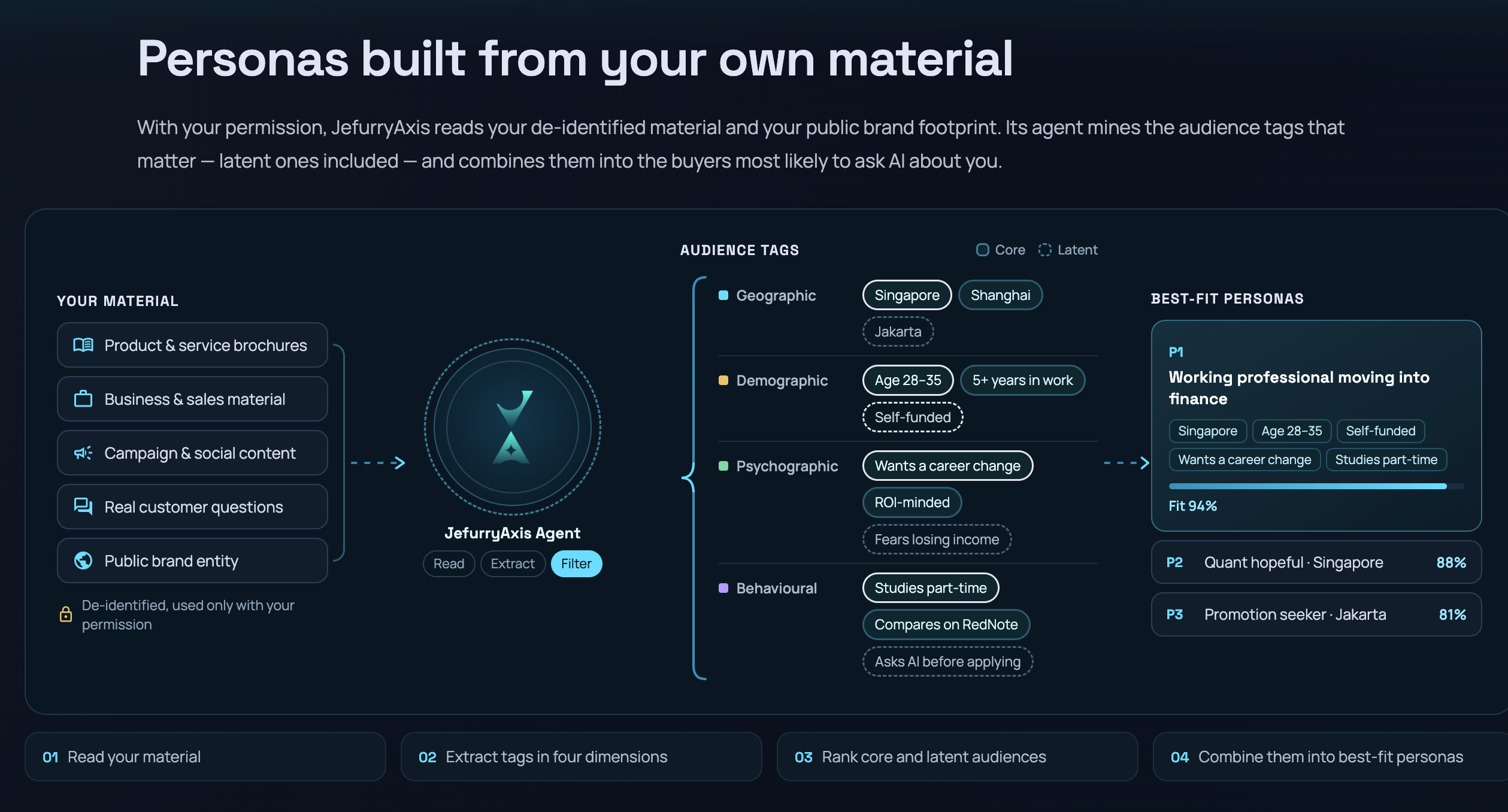
“The person” is not an age bracket plus a job title. It is a combination of around 20 relevant tags across four dimensions:
- Geographic — where they are
- Demographic — who they are: age, education, income
- Psychographic — how they think: risk appetite, ambition, decision style
- Behavioural — what they do: past behaviour, consumption patterns
Tencent is reportedly building around 3,000 tags for each user — down to whether they are connected to home Wi-Fi, a strong predictor of app-download intent. We distil this to the 20 tags most relevant to a client’s product, then cluster the combinations into three to five core buyer personas. The result is not a stereotype; it is a testable hypothesis about who your customer’s customer really is.
E: the environment — the context that changes everything
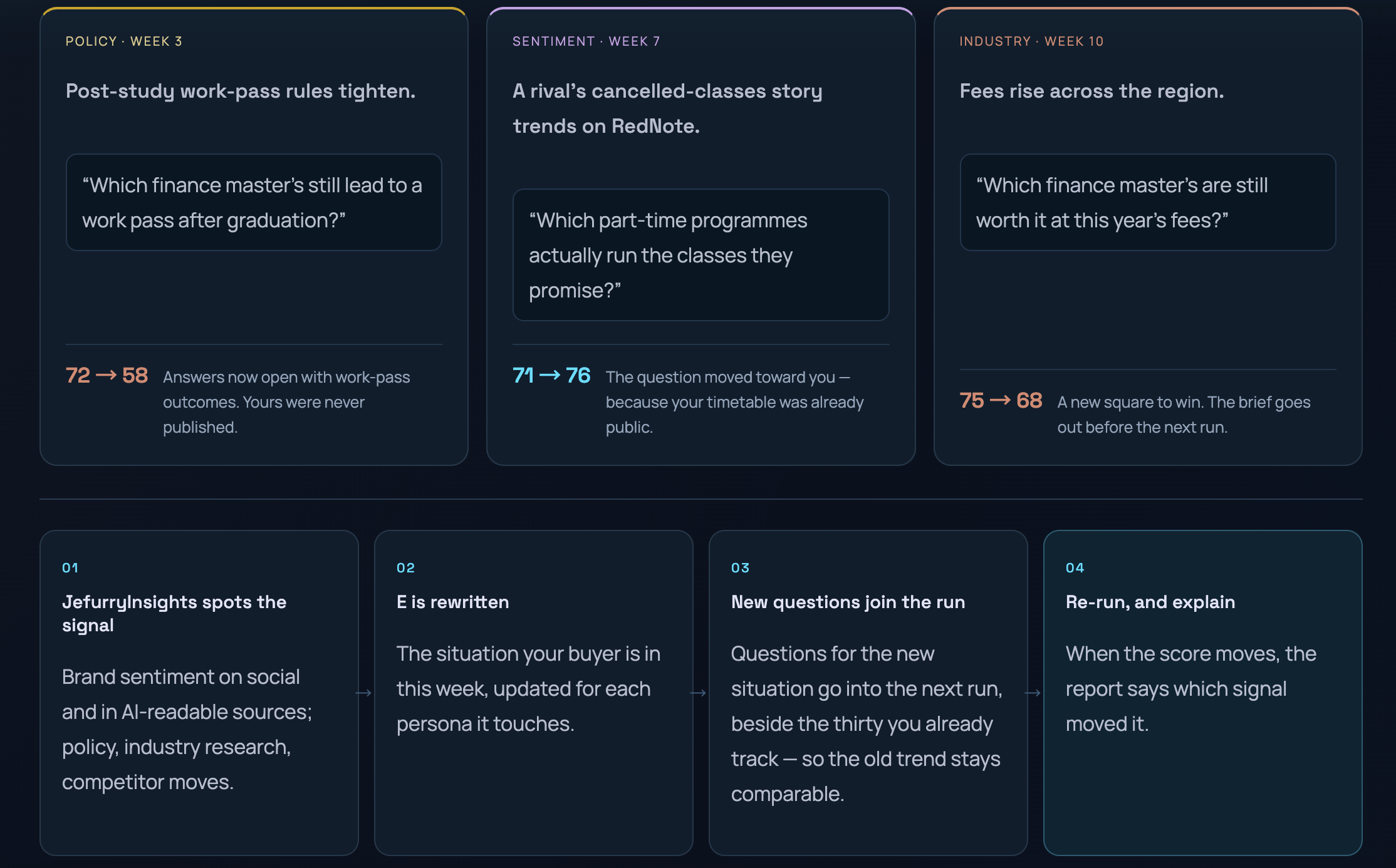
The same person behaves completely differently in different situations.
A prospective student who has just missed their postgraduate entrance exam asks AI very different questions from one who has always planned to study abroad.
A professional weighing an MBA in a strong job market weighs different factors from one considering it during a downturn.
We model this as a 8×5 matrix: eight personas × five situations, with each cell generating the questions that person would put to AI in that situation. This is exactly where most AI marketing falls short: it optimises keywords or generic prompts rather than the full persona–situation matrix. Keyword-based approaches will always miss intent; matrix-based approaches are built to capture it.

The standard configuration: a 40-question sweep
In practice, JefurryAxis’s standard audit configuration is 8 client-confirmed target-audience personas × 5 decision scenarios × 1 brand-word-free query per cell × 2 independent rounds = 40 queries. Each question is asked independently and repeatedly across multiple AI models, to reduce the variance of any single output.
A brand may be named in one of those questions and completely invisible in the other 39. Most brands have never counted that number — and the ones that do stop guessing where the marketing budget goes.

T: the touchpoint — the device that rewrites the answer
Ask the same question on a desktop, a phone, an in-car screen or AR glasses, and you will get different answers — because the touchpoint changes what is relevant. The phone knows where you are; the car knows where you are going; the glasses know what you are looking at.
As touchpoints evolve, the touchpoint variable T is becoming increasingly important, and the formula extends to:
Bₜ = f(P × Eₜ)
We are already seeing this in China: in-car AI assistants answer navigation and lifestyle questions differently from phone assistants. The next big shift — AR glasses — will be revolutionary. When you can ask your glasses a question and hear the answer, the click disappears. No clicks, no cost per click (CPC). The metric that has defined digital advertising for three decades stops working — and Bₜ = f(P × Eₜ), because it does not depend on clicks, becomes the framework that still holds.
Beyond AEO: the long-term view of the formula
B = f(P, E) is not limited to text-based AI search. It applies to:
- Image generation — which persona and situation does this image match, and what intent?
- Video — thirty frames every second, and every frame is an intent-matching opportunity.
- Non-player characters (NPCs) in immersive environments — when consumers enter AI-driven virtual worlds through glasses, cars or spatial computing, the NPCs they interact with need to understand who you are, where you are and what device you are using. That is B = f(P, E).
Companies that start building this capability now, from text AEO outward, are accumulating the data and methodology that will power the next generation of interaction.
Conclusion
Tactics change. Platforms rise and fall. Models keep updating. But the relationship between behaviour, person and environment does not change.
B = f(P, E) is the first principle that survives every technological shift. Build your marketing system on it, and you are not just optimising for today’s AI — you are building the infrastructure for everything that comes next.
Make your brand the answer AI recommends
Competition in the AI era is moving from being found to being recommended. If you would like to understand where your brand stands in AI answers today — where competitors are winning and where the opportunity is — book a complimentary Growth Diagnostic with Jeffery Asia. We will run the 40-question sweep against your buyer personas and their real decision contexts, and turn the results into a prioritised action plan: the right brand information, in the right answers, in the moments your customers decide.
Found this useful? Send it to a colleague or share it with your network.
More from the Insights Hub.
Turn market intelligence into measurable growth.
Book a complimentary Growth Diagnostic and we’ll translate the latest signals into a precision plan for your stage, goals and region.
