


How AI Video Went From Simple Tool to Table Stakes
Just last week, an entirely unknown model claimed the number one spot in the global AI video rankings. It arrived with zero announcements and zero press releases.
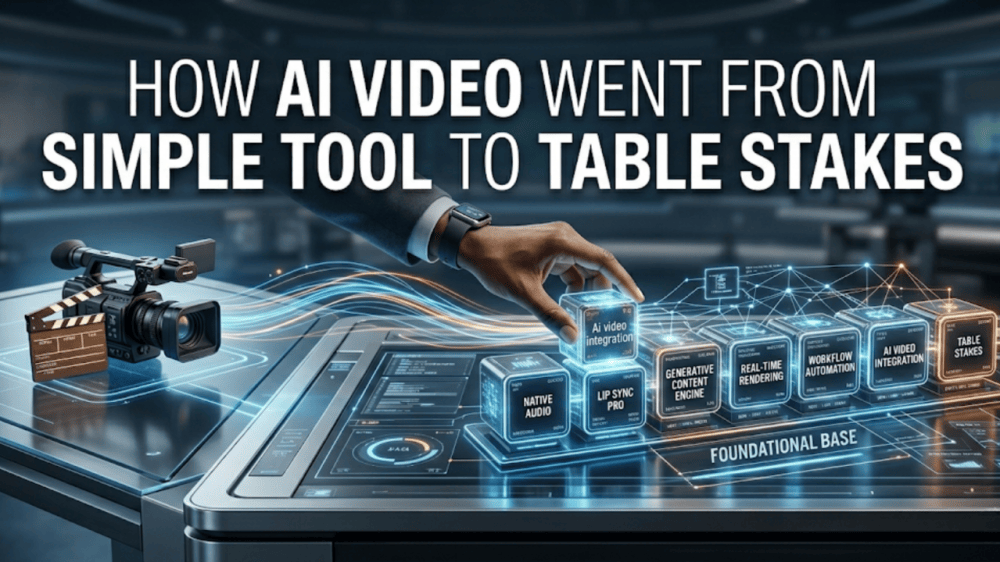
Just last week, an entirely unknown model claimed the number one spot in the global AI video rankings. It arrived with zero announcements and zero press releases. Following a simple anonymous upload to a benchmarking platform, it managed to dethrone every major player in exactly 72 hours. That model was HappyHorse 1.0, and it turned out to be from Alibaba.
For those of us in brand communications, content production, or institutional marketing, this sequence of events hits differently. The real story here is not about the benchmark figures themselves, but rather the stark reality they expose. The foundational ground of content production is shifting faster than anyone could have anticipated.
HappyHorse: The Model Nobody Expected
On April 7, a completely unknown model quietly surfaced on Artificial Analysis’s Video Arena. There was no company name and absolutely no origin story attached. Yet, within a matter of days, it secured Elo scores between 1333 and 1391 across both text to video and image to video categories, outperforming ByteDance’s Seedance 2.0 by a staggering 60 points.
The architecture comes from former Alibaba Taotian staff led by Zhang Di, the very same mind who previously built Kling AI at Kuaishou. The technical efficiency here is remarkable. Operating on a single NVIDIA H100 GPU, the model can generate 1080p video in exactly 38 seconds. Furthermore, it handles native lip synchronization across seven languages, including Mandarin and Cantonese. Both audio and video are generated simultaneously in a single pass, completely eliminating the need for separate post production workflows.
Beyond pure performance, the development team released the full model weights, distilled versions, and inference code directly on GitHub. For organizations that require strict data control or custom fine tuning capabilities, this offers a structurally different and far more powerful proposition compared to standard closed API access.
By the time Alibaba officially confirmed its involvement on April 10, the anonymous release had already accomplished its goal. The model successfully proved its worth through blind user preference tests long before anyone knew the creators behind it. This paradigm shift holds massive implications for content and production teams everywhere. The ultimate quality ceiling for AI video is no longer dictated simply by which tech giant possesses the most resources.
Sora Is Gone From Shelves. What That Signals.
In March 2026, OpenAI officially shut down the Sora consumer application. While the core model remains fully accessible through its API, the standalone consumer interface was closed a mere six months after the highly anticipated launch of Sora 2.
The official explanation cited a strategic pivot toward enterprise coding tools, corporate clients, and broader AGI development, all compounded by massive computing costs. Yet, the unspoken underlying signal is far more instructive. The simple truth is that running a high quality video generation interface at a global consumer scale incurs costs that standard subscription pricing cannot possibly support.
This specific move by OpenAI confirms a fundamental shift in our industry. AI video is rapidly transitioning from a novelty product into core structural infrastructure. The real commercial value now lies entirely in what organizations can build on top of these foundation models, rather than treating the models themselves as final consumer destinations.
Ultimately, the companies securing durable market positions today are those treating video generation as a foundational production layer embedded within a larger enterprise workflow. They recognize that generative video has moved beyond being a flashy feature to demo, and has officially become a critical engine for practical execution.
The Production Economy Has Officially Inverted
Here is the single metric that completely reframes the strategic conversation for content leaders everywhere. Traditional video production currently averages $4,500 per minute. In stark contrast, AI generated video runs at roughly $400 per minute. That represents a massive 91 percent reduction in baseline costs.
When scaling this to a 10 video social media campaign, the financial gap stretches from a negligible $89 to well over $100,000 for legacy methods. The macroeconomic impact is already undeniable. Globally, businesses saved $3.7 billion simply by switching to AI video in 2025. Now, the AI video market is firmly on track to hit $946 million in 2026. Technical capabilities are expanding at the exact same pace. Output lengths have evolved from a standard four to ten seconds in 2024 to highly coherent two minute single pass generation today.
To put this velocity into perspective, a 60 second marketing video that previously took 13 days to produce now requires exactly 27 minutes of execution time.
This reality does not imply that traditional production is entirely obsolete. Rather, it indicates that the threshold for justifying a physical shoot has shifted dramatically upward. What once demanded an entire production crew is now handled within a solo execution workflow. The defining competitive pressure in our industry is no longer a debate between using AI versus ignoring it. The true divide now lies entirely between teams that have engineered deliberate AI production systems and those that have not.
Audio Was the Final Missing Piece
Just six months ago, the vast majority of AI video models produced entirely silent clips. Fast forward to early 2026, and four of the six major production models, Kling 3.0, Sora 2, Veo 3.1, and Seedance 1.5 Pro, now generate synchronized audio natively. Sound effects that dynamically adapt to the environment, emotionally responsive music, and multilingual lip synchronization have all successfully transitioned from premium upgrades to standard default outputs.
Simultaneously, visual fidelity has scaled at an identical pace. Veo 3.1 officially crossed the broadcast resolution threshold by introducing 4K output at 60 frames per second this past January. Across the broader market, most models now deliver 1080p as the baseline standard, marking a massive technical leap from the restrictive 512 by 512 constraints the industry operated under just eighteen months ago.
The practical operational result here is profound. Major campaigns that historically required a dedicated sound designer, a video editor, and a motion graphics specialist can now be fully executed by a single individual armed with a clear creative brief and a systematically engineered prompt workflow.
The Strategic Implications for Brand and Institutional Content Teams
There are three structural shifts that now demand deliberate execution.
First, the differentiation window is rapidly closing. Organizations that adopted AI video early in 2024 enjoyed a highly visible output advantage. However, as we move deeper into 2026, the vast majority of content teams will consider this baseline standard. Moving forward, true competitive advantage will no longer reside in mere tool access, but rather in proprietary workflow design and absolute creative quality.
Second, multilingual execution is now structurally affordable. HappyHorse 1.0 delivers native support across Mandarin, Cantonese, Japanese, Korean, English, German, and French. This capability completely dismantles the traditional cost barriers associated with scaling localized video. For high tier institutions specifically targeting Chinese speaking audiences, this effectively eliminates an operational gap that previously demanded entirely separate localization budgets.
Third, open source architecture is fundamentally rewriting the risk equation. Having full model weights and inference code readily available on GitHub means organizations can now deploy production systems locally. They can securely fine tune generation on their own proprietary material and completely avoid vendor lock in.
How We Execute This in Practice
Our proprietary AI video execution system operates across a five stage process. This includes Preliminary Planning, Visual Shaping, Dynamic Generation, Late Stage Synthesis, and Quality Enhancement. Rather than committing entirely to a single platform, every production task is deliberately routed to the specific tool best suited to drive that exact requirement.
When delivering the recent water ink art campaign for the China National Tourist Office in Singapore, the critical variable was never simply which foundation model ranked highest. The true differentiator was identifying exactly which combination of tools, spanning Gemini, Kling AI, Midjourney, Veo 3, Suno, and DaVinci Resolve, could generate the most highly controllable and brand consistent output for that specific strategic brief.
While the baseline cost reduction compared to legacy production is undeniably real, the far more consequential shift lies in production cadence. Organizations that previously managed to produce only one or two major video assets per year can now sustain a rigorous monthly content cycle, all at a mere fraction of their original budget.
Consequently, the primary question we now hear from top tier institutional clients is no longer whether they should utilize AI video. Instead, they are asking how to engineer a robust execution system that holds up at high volume while strictly maintaining premium brand standards. That is a fundamentally harder problem to solve. It is also the exact challenge worth solving today, right now, before the window for any early mover advantage permanently closes.
To discuss how we approach AI video production for institutional clients, visit jeffery.asia or write to success@jeffery.asia.
Found this useful? Send it to a colleague or share it with your network.
Turn market intelligence into measurable growth.
Book a complimentary Growth Diagnostic and we’ll translate the latest signals into a precision plan for your stage, goals and region.
