
3


Your Website Won’t Get You into AI Recommendations Alone
Filling out your website isn’t enough to win AI recommendations. Because each AI model draws on a different source ecosystem, AEO means mapping where your target model actually looks, placing the right information in the right channels, and monitoring continuously.
In the first two articles in our AEO series, we explored how AI is influencing users’ decisions earlier in the journey and how brands can assess their visibility within AI-generated answers. This time, we are looking at a more practical question: once we know the scenarios in which a brand is not being seen, where should optimisation begin?
For many brands, the instinctive response is: start with the website. There is nothing wrong with that. A website is a brand’s most stable and controllable official information asset, and one of the key sources AI uses to identify and understand a brand. But in AEO, simply filling out the website and making the copy longer does not mean the brand will appear across every AI answer ecosystem. The reason is straightforward: different AI models rely on entirely different source ecosystems.
AEO is never about finding a universal writing formula that ‘every AI likes’. It is about first understanding which sources the target model relies on, then ensuring the right information enters the right information ecosystem.
Your website matters, but making it ‘readable’ to AI matters more than adding more content
In an AEO audit of a university website, we identified several highly typical issues: the pages lacked a clear heading hierarchy; the homepage contained multiple H1 headings; key information was hidden inside collapsed modules that had to be opened; essential details such as event times, locations and time zones were not marked up in a structured way; and many pages were burdened with bloated content and code.
For human visitors, these may not seem like serious problems – at worst, they make information slightly harder to find. For AI, however, they significantly increase the difficulty of reading the page, understanding the information hierarchy and extracting key facts. When a page contains a large volume of content but does not clearly tell the machine what kind of page it is, which information matters most, or how the content is hierarchically related, the cost of understanding it becomes much higher.
Website AEO is therefore never simply about adding more words or expanding the amount of content. The real priorities are to make the structure clear, keep information accurate and up to date, define the hierarchy explicitly, and present key facts in formats that AI can recognise as readily as possible.
Different AIs draw from entirely different information sources
Once the website is in good shape, do not rush to produce more content at scale and distribute it everywhere. The second step is to understand where the AI you are targeting actually gets its answers.
Our testing shows:
- Leading international large language models tend to retrieve information from brand websites, authoritative third-party sites, professional communities and the open web;
- Chinese-language large language models are more likely to cite education websites, media coverage and content platforms within the Chinese internet ecosystem;
- More closed, platform-native AI systems, such as AI assistants built into apps, rely heavily on sources within their own platforms.

This means that content cited by Model A may have little or no effect in Model B. The core of AEO is never to ‘write one universal piece of copy that every AI will consume’. It is to map the target model’s source structure first, then place the relevant content in the relevant channels.
In closed platform ecosystems, the official account is only one source among many
Xiaohongshu (RedNote) is a good example. In our tests, its in-platform AI Q&A synthesised answers from posts across a wide range of ordinary user and creator accounts. Even if a brand’s official account is comprehensive and authoritative, it is still only one source within the wider information pool.
This breaks with the playbook most brands are used to:
- On the open web, a strong website supported by authoritative third-party validation can make a clear difference;
- In closed platform ecosystems, however, content quality alone is not enough. You also need to consider content volume, the diversity of account types and the consistency of updates. When the same core information is repeatedly validated through multiple authentic content nodes, AI is more likely to trust and use it.
AEO therefore is not simply about ‘rewriting official copy in a way AI prefers’. Often, the more important questions are: which channels does the AI used by your target audience actually trust? And does your brand have sufficient information coverage across those channels?
When creating AEO content, do not start only with ‘what the brand wants to say’
Only after mapping the source ecosystem does content production truly begin. We believe effective AEO content should be shaped by five types of input, rather than by the brand simply talking to itself:
- Market insight: what users are discussing now, what concerns them, and how the topics they care about are changing;
- Brand priorities: the core information that must be communicated, such as product or programme features, event arrangements and the latest policies;
- Source ecosystem characteristics: which channels the target model tends to use for information, and what content structures those channels favour;
- Brand governance requirements: compliance boundaries, standardised terminology, naming conventions, visual guidelines and other brand consistency requirements;
- Real user questions: what prospects and customers have been asking most frequently over the past week or month, where they hesitate in the decision journey, and why they are still comparing options rather than committing.
Content built from these five inputs is more than simply ‘another brand post’. It is designed around the questions users are actually likely to ask AI at key decision points.
AEO is an ongoing cycle of experimentation, not a one-off technical fix
Even after content has been placed precisely in the right sources, the work is far from over. AI models continue to evolve, source weightings change dynamically, and new content appears on platforms every day. We have already observed that content visibility on many platforms declines noticeably over time. This is clear evidence that a one-off optimisation cannot deliver lasting results.
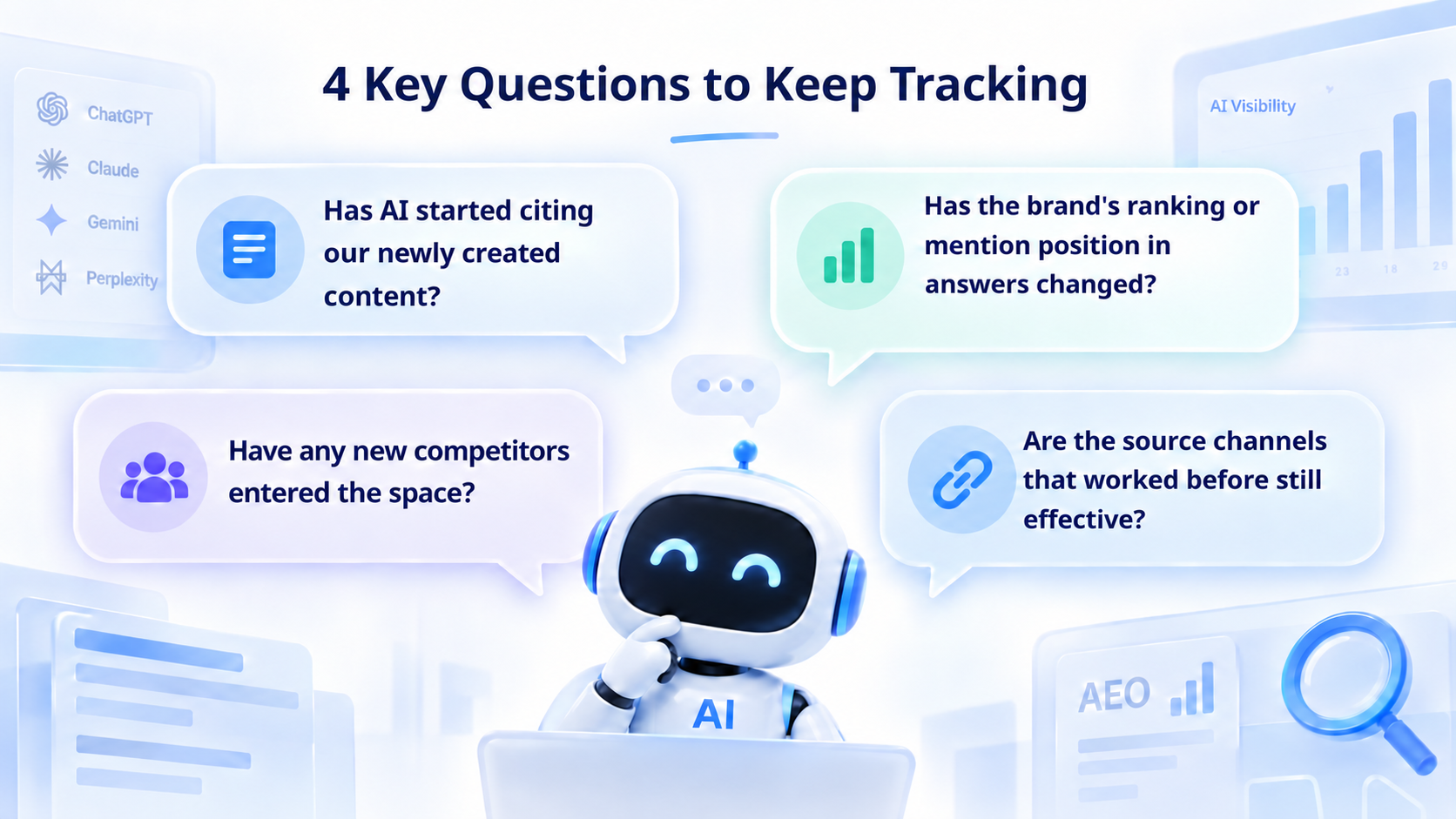
After publishing, you therefore need to keep retesting against the same audience personas and question scenarios: Has AI started citing the new content? Has the brand’s ranking or position within answers changed? Have new competitors appeared? Are previously effective source channels still working?
This is why we emphasise continuous, periodic monitoring rather than declaring ‘optimisation complete’ at a single point in time. AEO methodology itself evolves as models and information ecosystems change. What delivers lasting value is not any universal writing formula, but a closed-loop capability to monitor, learn, adjust and retest continuously.
From optimising a piece of content to managing and building your brand’s information assets
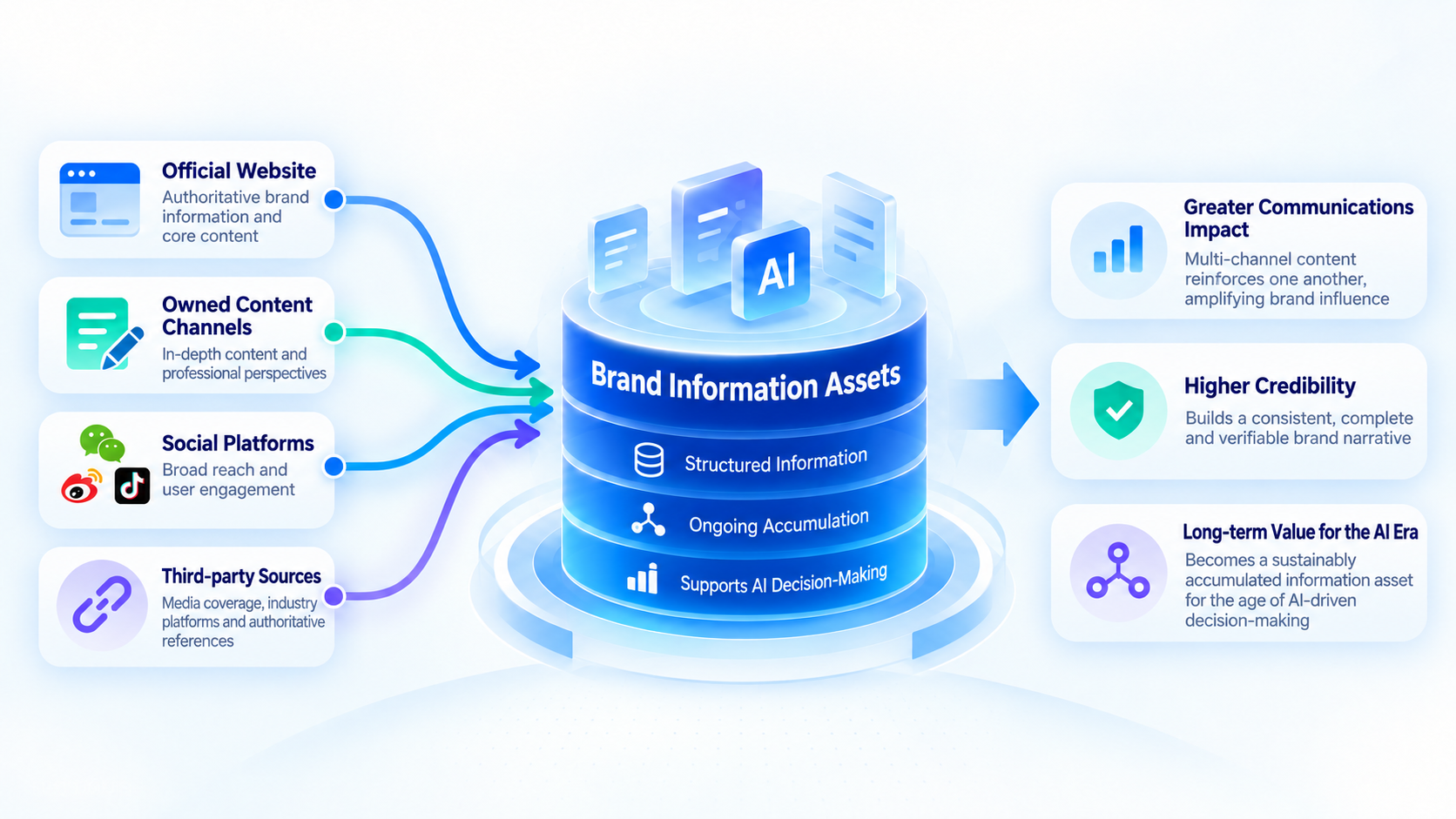
As the way users access information shifts from lists of web search results to complete answers generated by AI, brands can no longer focus only on their website, SEO or a handful of social accounts. They need to manage a broader AI information ecosystem: Can AI clearly read and understand the website? Is there credible brand content across third-party channels? Are there sufficiently diverse, authentic sources within platform ecosystems? Are the questions users care about most being answered accurately?
For Jeffery Asia, the ultimate goal of AEO is not to make a brand name appear everywhere. It is to ensure that the right brand information appears in the right source channels, and then to use continuous monitoring to confirm that AI is genuinely adopting that information and incorporating it into the answers users receive.
Only then do the website, content accounts, social platforms and third-party sources stop operating as isolated communication channels and start building a durable, compounding information asset for the brand in the age of AI-driven decision-making.
If you are also exploring how to get your website, third-party content and social platforms working together to enter AI answer ecosystems, contact success@jeffery.asia or visit jeffery.asia. We can help you pinpoint where to optimise first based on your target audiences, real decision scenarios and the source characteristics of different models, then validate the impact through ongoing monitoring — so the right brand information appears in the right sources and at the right points in the user’s decision journey.
Found this useful? Send it to a colleague or share it with your network.
Turn market intelligence into measurable growth.
Book a complimentary Growth Diagnostic and we’ll translate the latest signals into a precision plan for your stage, goals and region.
